Our Experience at EvolaTec
Over the past few years, we at EvolaTec have developed dozens of websites for companies across Germany — from small local businesses to e-commerce projects and corporate platforms. One of the most common questions we hear from our clients is:
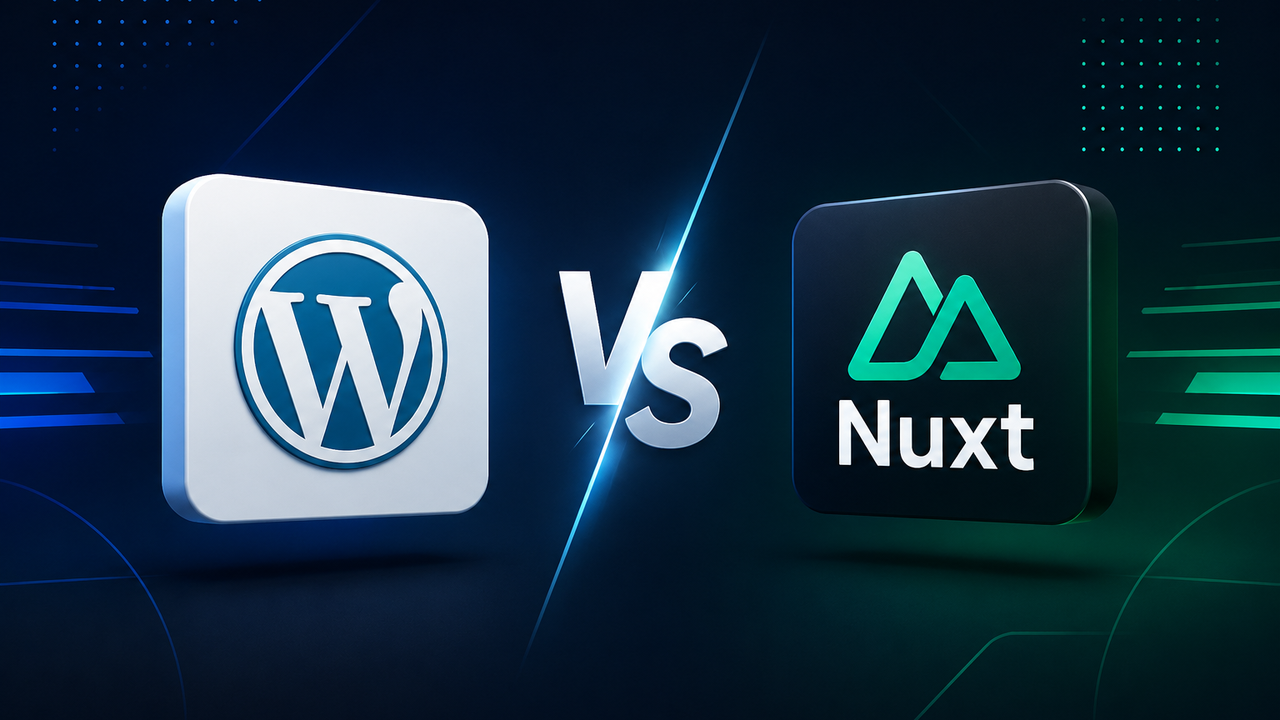
“What is the better choice in 2026 — WordPress or Nuxt?”
And this is actually a very important question. Because the choice of technology directly affects loading speed, Google SEO rankings, conversion rates, maintenance costs, security — and even the future scalability of the business.
In this article, I’ll explain in detail what Nuxt is, how it differs from WordPress, which technology is better for SEO and GEO optimization, how strongly website speed affects businesses in 2026 — and why more and more modern agencies are moving away from traditional CMS platforms in favor of framework-based development.
What Is WordPress?
WordPress is a CMS (Content Management System) that was originally developed in 2003. It started as a blogging platform, but over time WordPress evolved into a universal system for website creation.
Today, around 43% of all websites on the internet run on WordPress. An impressive number. But it’s important to understand:
Popularity ≠ Modernity.
Most WordPress websites today are small business sites, blogs, landing pages, WooCommerce stores, and projects built using pre-made templates.
The key characteristic of WordPress is that almost all functionality depends on plugins and ready-made themes. This allows for fast setup and a low entry barrier — but at the same time creates serious limitations in terms of performance and scalability.
What Is Nuxt?
Nuxt is a modern JavaScript framework built on top of Vue.js.
Nuxt is not a website builder — it is a full-fledged modern development system for high-performance web applications and websites.
At EvolaTec, we rely on a modern stack based on Vue.js, Nuxt.js, Tailwind CSS, and TypeScript — because this architecture allows us to build fast, scalable, and SEO-oriented projects.
This approach enables us to develop ultra-fast websites with high SEO efficiency, modern UX, and excellent conversion performance — without the burden of outdated legacy architecture.
Why Nuxt Is Better for SEO
Today, Google evaluates not only content, but also loading speed, Core Web Vitals, mobile UX, HTML structure, interface stability, and the overall technical quality of a website.
Nuxt supports SSR (Server-Side Rendering) out of the box, allowing Google to receive fully rendered HTML with fast rendering and proper page indexing — practically without JavaScript-related issues.
WordPress websites often suffer from LCP times of 4–8 seconds, excessive JavaScript, and weak mobile scores — especially when built with page builders. With Nuxt, we regularly achieve 90–100 scores in Google PageSpeed, LCP times around 1–2 seconds, and extremely fast Time to Interactive — even on mobile devices.
Why Nuxt Is More Secure
Nuxt does not depend on dozens of plugins, outdated themes, or legacy PHP code — making the architecture significantly cleaner and more secure.
The modern architecture provides a smaller attack surface, reduces vulnerabilities, and allows better control over the project infrastructure. This is especially important for e-commerce, SaaS, B2B, and corporate platforms, where security directly impacts user trust and business stability.
| Security Factor | WordPress | Nuxt |
|---|---|---|
| Dependency on Plugins | Very high | Minimal |
| Risk of Vulnerabilities | High | Low |
| Legacy Code | A lot | Almost none |
| Control Over Architecture | Limited | Complete |
Why We at EvolaTec Use Nuxt
Over the years, we tested WordPress, Elementor, Shopify themes, various CMS platforms, and page builders. In the end, we came to the conclusion that modern websites should be developed as full-fledged web applications — not as collections of plugins layered on top of outdated CMS systems.
That’s why today we rely on Nuxt.js, Vue.js, Tailwind CSS, and TypeScript. This stack allows us to create ultra-fast websites with SEO-first architecture, premium UX, and high scalability — without compromising performance.
| What Matters for a Modern Website | WordPress | Nuxt |
|---|---|---|
| Loading Speed | Average | Very high |
| Core Web Vitals | Often unstable | Excellent |
| SEO Potential | Limited by plugins | Maximum flexibility |
| UX/UI Capabilities | Restricted by CMS | Complete freedom |
| Scalability | Medium | High |
Conclusion
In short: WordPress is still suitable in 2026 for inexpensive websites, simple projects, blogs, and MVPs. However, it is increasingly reaching its limits in terms of speed, SEO, security, scalability, and technical debt.
Nuxt, on the other hand, is significantly better suited for SEO, GEO SEO, performance-oriented projects, modern UX, e-commerce, and digital branding. If a company wants to grow quickly, generate leads through Google, run effective advertising campaigns, and present itself as modern compared to competitors, Nuxt is currently one of the best solutions on the market.
Final Thoughts
A website today is no longer just a “business card.” It is a fully-fledged sales tool, an SEO asset, a marketing platform, and the digital face of a brand.
That’s why the choice of development technology plays a critical role. At EvolaTec, we focus on performance, SEO from day one, modern technologies, and custom development without templates.
Because in 2026, it’s not simply beautiful websites that win — but fast, technically advanced, and SEO-optimized platforms.