TL;DR
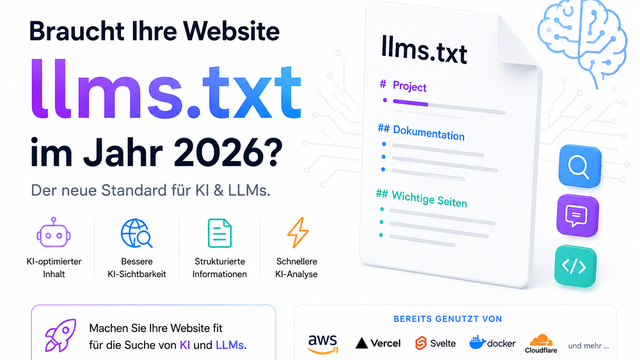
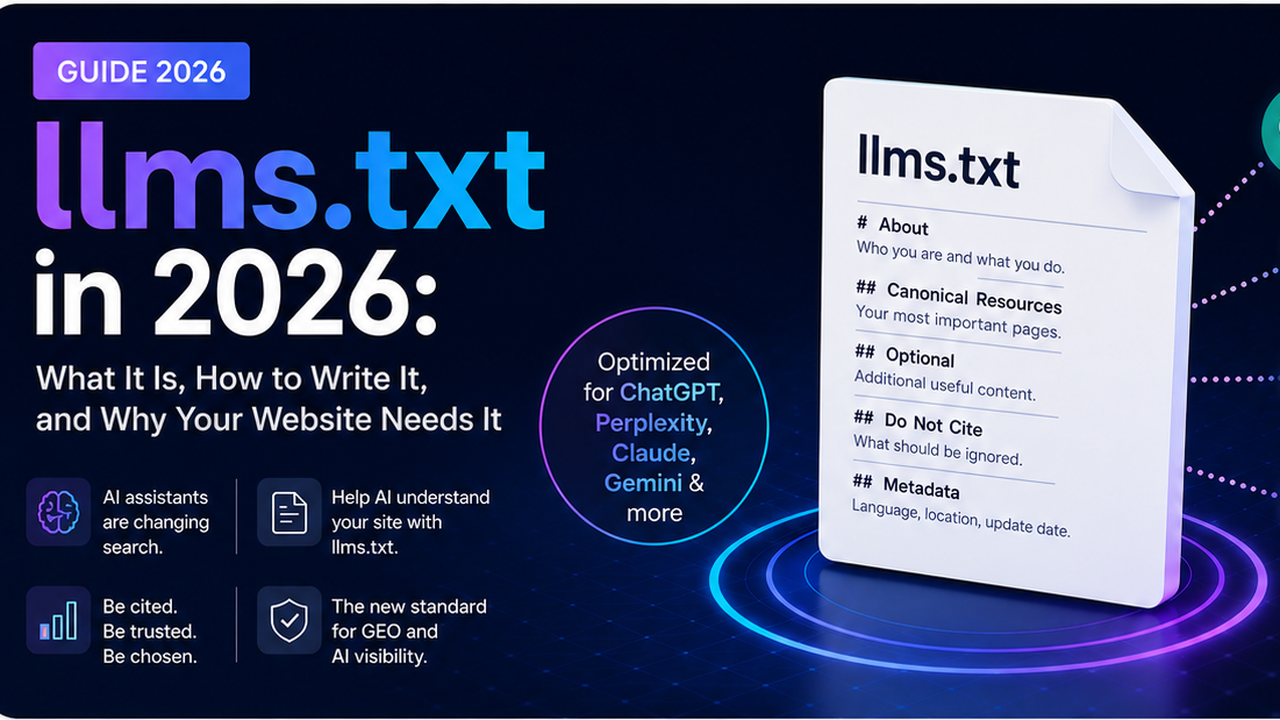
llms.txt is a file placed in your website root that explains your project to AI models: what your company does, which pages are authoritative, what should be cited, and what should be ignored.
In 2026, AI assistants already read these files. Most websites still do not have one. That means AI systems often misunderstand them — or never mention them at all.
The file takes less than an hour to create. In many cases, websites start appearing more often in AI-generated answers within several weeks.
Search Has Changed. SEO Hasn’t
Three years ago, website visibility meant one thing: ranking high in Google.
Fast pages, schema.org markup, backlinks, content clusters — the standard SEO stack.
Today, the user journey looks completely different.
Before
- Search in Google
- Open 5–10 tabs
- Compare manually
- Visit websites directly
Now
- Ask ChatGPT or Perplexity
- Receive one summarized answer
- Open only 1–2 cited sources
- Ignore the rest
This is the biggest shift in search behavior since Google itself appeared.
AI assistants do not “rank pages” the same way traditional search engines do. They synthesize information. They decide which websites deserve to become part of the final answer.
If your site is not understood clearly, you disappear from AI search entirely.
What Is llms.txt?
llms.txt is a structured markdown file placed in the root of your domain:
https://yourdomain.com/llms.txtIt acts as a semantic guide for language models.
Instead of forcing AI crawlers to analyze your entire homepage, navigation, animations and layouts, you provide a clean summary of:
- Who you are
- What your business does
- Which pages matter most
- What content is authoritative
- What should not be cited
Think of it as a hybrid between:
- robots.txt
- sitemap.xml
- structured documentation
— but designed specifically for AI systems.
llms.txt vs robots.txt
| Feature | robots.txt | llms.txt |
|---|---|---|
| Main purpose | Access control for crawlers | Semantic understanding for AI models |
| Format | Directives | Markdown |
| Human-readable | Partially | Yes |
| Controls indexing | Yes | No |
| Explains content meaning | No | Yes |
| Used by AI assistants | Partially | Yes |
| Supports canonical resources | No | Yes |
The important thing to understand:
robots.txt tells crawlers where they can go.
llms.txt tells AI systems what actually matters.
Why AI Crawlers Need This File
Traditional search engines build huge indexes in advance.
AI assistants often work differently.
When a user asks:
“Which agency builds fast business websites in Germany with SEO included?”
the AI system may:
- Search the web in real time
- Collect 5–10 candidate websites
- Parse content extremely quickly
- Select 1–3 sources to cite
- Generate one final answer
This entire process can happen in seconds.
AI crawlers do not want to parse your entire design system, animations, sliders, cookie popups, or navigation menus.
They want structured information immediately.
That is exactly what llms.txt provides.
What Should Be Inside llms.txt?
After testing multiple production websites, I found that the most effective files usually contain five core sections.
1. Summary
# EvolaTec

> EvolaTec is a web development and online marketing agency in Germany.
> We build business websites, landing pages and SEO systems focused on measurable growth.
This is the most important section. AI systems often reuse this exact summary when describing your company.
2. Canonical Resources
## Services

- Business Websites: https://evolatec.de/business-website/
- SEO Optimization: https://evolatec.de/seo/
- AI Optimization: https://evolatec.de/ai-optimization/
Think of this as your “AI sitemap”.
3. Optional Resources
## Optional

- Blog
- Case Studies
- Pricing
- FAQ
4. Non-canonical Content
## Do Not Cite

- Old blog posts
- Internal admin pages
- Temporary landing pages
5. Metadata
## Metadata

Languages: en, de
Location: Germany
Updated: 2026-05-28
llms.txt vs llms-full.txt
| Feature | llms.txt | llms-full.txt |
|---|---|---|
| Purpose | Short AI overview | Extended AI knowledge source |
| Typical size | 500–2,000 words | 10,000–50,000+ words |
| Contains summaries | Yes | Yes |
| Contains full articles | No | Yes |
| Used for quick discovery | Yes | Partially |
| Used for detailed AI answers | Limited | Yes |
For most business websites, a standard llms.txt file is enough.
If you have technical documentation, detailed case studies, or hundreds of blog articles, then creating llms-full.txt becomes valuable.
Why FAQ and Structured Data Matter More Than Ever
AI systems prefer structured information.
FAQ blocks, comparison tables, step-by-step lists, and schema.org markup make your content dramatically easier to extract.
In many tests, pages with:
- FAQ sections
- HowTo schema
- Service schema
- Organization schema
- clear H2/H3 hierarchy
were cited noticeably more often by AI assistants.
AI models do not “read” content like humans. They detect patterns and structures.
Well-structured content becomes easier to trust.
How to Validate That GEO Is Actually Working
Measuring traditional SEO is easy.
Measuring AI visibility is much harder.
But there are already reliable signals.
-
Ask AI assistants directly
Search for your service category weekly in ChatGPT, Claude and Perplexity. -
Monitor crawler logs
Check if GPTBot, ClaudeBot or PerplexityBot visit your llms.txt file. -
Track branded searches
Users often search your brand after seeing it inside AI responses. -
Watch referral traffic
Traffic from ChatGPT and Perplexity already appears in analytics platforms. -
Ask new leads
Add “AI assistant” as an option in your contact forms.
Common Mistakes
- Creating an empty file with only a title
- Stuffing keywords unnaturally
- Copying homepage text directly
- Never updating the file
- Blocking AI crawlers in robots.txt
- Not using structured data
- Having no FAQ sections
The Real Shift Happening Right Now
The biggest change is not technical.
Visibility is moving away from rankings and toward citations inside AI-generated answers.
Traditional SEO fought for the first position in Google.
GEO fights for inclusion inside the AI response itself.
Those are completely different systems.
Websites that adapt early gain a massive advantage while the space is still relatively empty.
Want Your Website to Appear in ChatGPT & AI Search?
At EvolaTec, we build websites optimized not only for Google — but also for AI assistants like ChatGPT, Gemini, Claude and Perplexity.
That includes:
- llms.txt implementation
- AI-friendly content structure
- FAQ optimization
- schema.org markup
- Core Web Vitals optimization