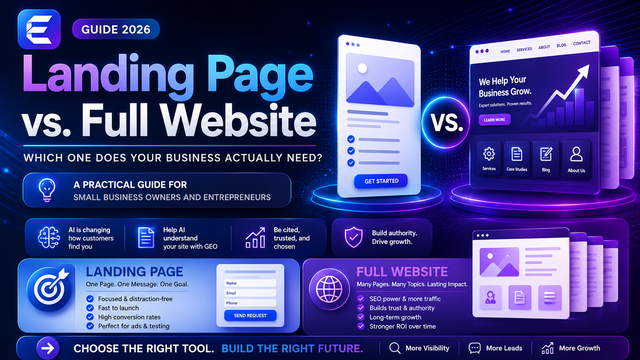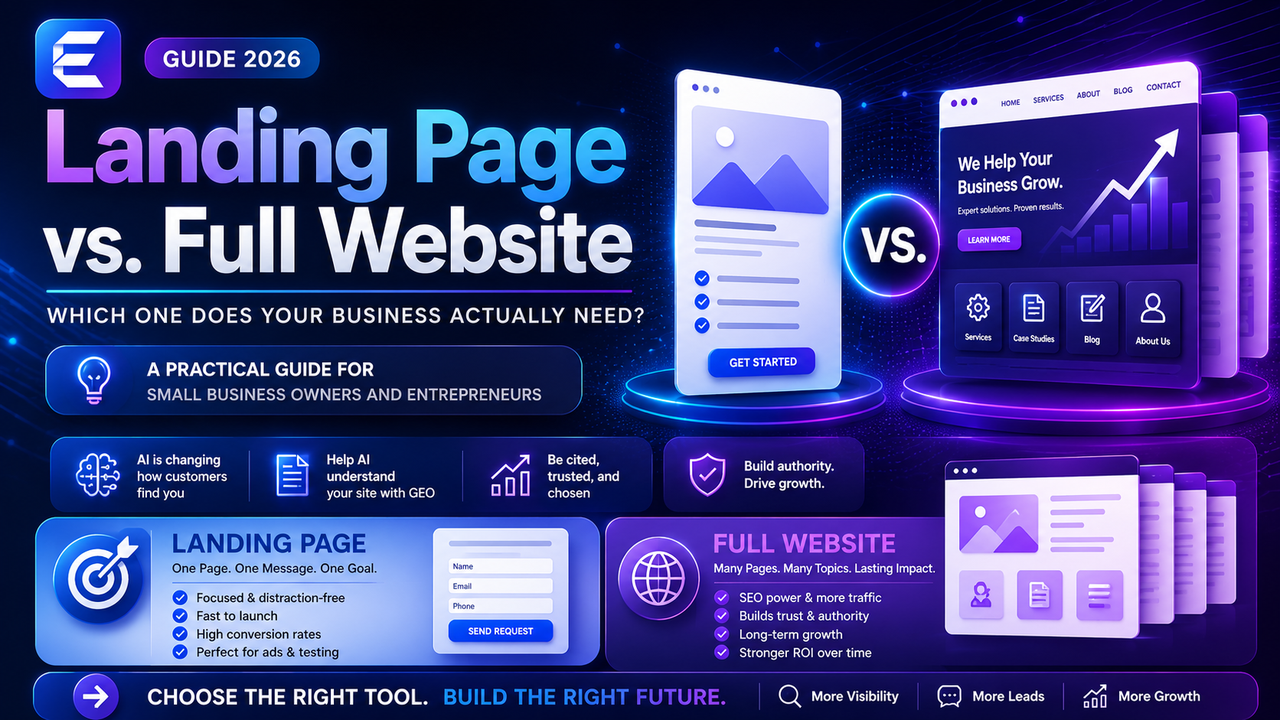
Which One Does Your Business Actually Need?
A practical guide for small business owners and entrepreneurs
Table of Contents
- Introduction
- Quick Answer — For Those in a Hurry
- What Is a Landing Page?
- What Is a Full Website?
- Key Differences at a Glance
- When a Landing Page Is the Right Choice
- When a Landing Page Becomes a Problem
- When You Need a Full Website
- What Does Each Option Cost?
- Which Is Better for Google Search (SEO)?
- Which Is Better for AI Search? (GEO)
- Real Business Scenarios
- Frequently Asked Questions
- Conclusion
1. Introduction
Every year, thousands of small business owners spend money on the wrong type of website — and only realize it months later.
You hire a web designer, invest weeks of your time explaining your business, and finally launch your new site. But leads don't come. The phone doesn't ring. Your investment sits online, generating nothing.
In most cases, the problem isn't the design or the copywriting. The problem is the format. A business that needed a single, focused landing page paid for a full multi-page website — or vice versa. The result: wasted money, wasted time, and a missed opportunity to grow.
This guide was written specifically for entrepreneurs and small business owners who don't have a technical background. We'll cut through the jargon and give you a clear, honest framework for choosing the right type of website for your goals.
What you'll learn in this guide:
- The real difference between a Landing Page and a full website
- When a Landing Page will generate more leads than a 10-page site
- When only a full website will do the job
- How each option performs in Google search and AI tools like ChatGPT
- Real-world examples from common business types
- Honest pricing for both options
By the end, you'll know exactly which path to take — no guesswork, no wasted budget.
2. Quick Answer — For Those in a Hurry
Not everyone has time to read a full guide. If you need a fast answer, use this table:
| If You Need To... | Choose |
|---|---|
| Quickly test a new niche or idea | Landing Page |
| Advertise a single service with paid ads | Landing Page |
| Build a long-term brand | Full Website |
| Rank in Google search results | Full Website |
| Sell multiple services to different audiences | Full Website |
| Get leads from Google Ads (PPC) | Landing Page |
| Build a long-term digital asset | Full Website |
| Publish blog articles and expert content | Full Website |
💡 Still not sure? Keep reading — the sections below explain the reasoning behind each recommendation, with real examples.
3. What Is a Landing Page?
A landing page is a single web page with one clear purpose: to convert visitors into leads or customers.
Everything on the page — the headline, the images, the text, the button — points toward a single action. There is no navigation menu pulling visitors away to other sections. There are no distractions. Just one message, one audience, one goal.
A typical landing page follows this simple structure:
| Section | Purpose |
|---|---|
| Headline | Grabs attention and states the core benefit in one sentence |
| Key Benefits | Explains what the customer gets and why it matters to them |
| Social Proof | Testimonials, reviews, logos, or case study summaries that build trust |
| FAQ | Answers the top objections before they become a reason not to contact you |
| Contact Form / CTA | The single, clear action you want the visitor to take |
Real-world example:
"Streak-Free Window Cleaning in Dublin — Book Online, Results Guaranteed"
Below that: your three main benefits. Then a few five-star reviews. Then a simple form: Name, Phone, Address, Preferred Date. Done.
That page has one job: get people to fill in the form. It does it well because there's nothing else to do on the page.
Landing pages are typically built in 1–2 weeks and cost significantly less than a full website. They are the right tool when your goal is simple, your audience is specific, and you want results quickly.
4. What Is a Full Website?
A full website is a multi-page digital presence for your business. Rather than a single page focused on one conversion, it covers the complete picture of who you are, what you offer, and why you should be trusted.
A typical business website includes:
- Homepage — First impression, overview of services, trust signals
- Services pages — One or more dedicated pages for each service you offer
- About page — Your story, team, values, and what makes you different
- Case Studies / Portfolio — Proof that your work delivers results
- Blog — Educational articles that bring in organic traffic from Google
- Contact page — Multiple ways to reach you, map, business hours
Think of a full website not as a page, but as an ecosystem. Each part serves a different purpose and a different visitor — someone who found your blog post, someone comparing your prices, someone checking your credentials before signing a big contract.
This ecosystem takes more time and money to build. But it also compounds over time. A blog post you publish today can bring in free traffic three years from now. A well-structured services page can rank in Google for dozens of search terms. A full website is not just a cost — it is an asset.
🌿 A landing page is a sprint. A full website is a marathon — and marathons build the kind of endurance that makes businesses last.
5. Key Differences at a Glance
Here is a direct comparison across the factors that matter most to a business owner:
| Criteria | Landing Page | Full Website |
|---|---|---|
| Number of pages | 1 | 5 to hundreds |
| Typical cost | €800–2,500 | €2,500–10,000+ |
| Time to launch | 1–2 weeks | 3–8 weeks |
| SEO potential | Limited | Very high |
| Google Ads performance | Excellent | Good |
| Scalability | Difficult | Easy |
| Multiple services | Poor fit | Excellent fit |
| Brand building | Moderate | Excellent |
| AI search visibility (GEO) | Moderate | Excellent |
| Long-term ROI | Moderate | High |
Notice that landing pages aren't "worse" — they are simply a different tool. A hammer isn't better or worse than a screwdriver. It depends entirely on what you're building.
6. When a Landing Page Is the Right Choice
There are specific situations where a landing page will outperform a full website — even one that cost ten times more to build.
6.1 Launching a New Service
You've decided to add a new offering to your business. Maybe you're a plumber who now wants to offer bathroom renovations. Or a freelance designer who's launching a logo design package.
Before you invest in building out a complete section of your website, test the concept with a landing page. Put it in front of real customers. If the leads come in, you know the service has a market. If they don't, you've spent €1,200 instead of €6,000 to learn that lesson.
- Cleaning company launching a post-construction cleaning service
- Solicitor offering a fixed-fee will-writing package
- Fitness instructor launching online coaching for the first time
6.2 Testing a New Market or Niche
Thinking about expanding to a new city? Wondering whether there's demand for a premium version of your service? A landing page is the fastest, cheapest way to test a hypothesis.
Run €200 worth of Google Ads to the page. If you get 10 enquiries in a month, you have your answer. Scale up. If you get zero, you've paid for a valuable lesson, not a €5,000 website.
💡 Testing before building is one of the most important habits of successful entrepreneurs. A landing page makes testing affordable.
6.3 Running Google Ads (Pay-Per-Click Campaigns)
This is where landing pages genuinely outperform full websites — and the reason is psychological.
When someone clicks a Google Ad and lands on your homepage, they face choices: the navigation menu, links to your blog, your about page, your other services. Each choice is a distraction. Each distraction reduces the chance they fill in the contact form.
A landing page removes all of that. The visitor arrives, sees exactly what they were promised in the ad, and has one clear action to take. That's why landing pages consistently produce higher conversion rates in paid ad campaigns.
| Scenario | Conversion Rate (approx.) |
|---|---|
| Google Ad → Homepage | 1–3% |
| Google Ad → Dedicated Landing Page | 4–12% |
If you're investing in paid traffic, a well-built landing page can pay for itself within weeks.
7. When a Landing Page Becomes a Problem
A landing page is a powerful tool — but only for the job it was designed to do. The moment your business grows beyond that job, the limitations start to show.
7.1 You Can't Rank for Multiple Search Terms
Search engine optimization (SEO) is built on pages. One page = one primary topic. To rank in Google for many different searches, you need many different pages.
Consider an air conditioning company. They want to be found by people searching for:
- AC installation
- AC repair
- AC servicing and maintenance
- Best AC brands
- AC installation cost
Those are five completely different search intentions. One landing page cannot effectively target all five — Google will not know which topic to rank it for. A full website with a dedicated page for each topic can rank for all of them simultaneously.
⚡ Every page of your website is a separate opportunity to appear in Google. One page = one opportunity. Twenty pages = twenty opportunities.
7.2 You Can't Build Authority or Expertise
Buyers — especially for higher-value services — do their research before making contact. They want to see evidence that you know what you're talking about. A landing page rarely provides enough space to demonstrate that.
A full website gives you the room to show:
- Detailed case studies with real results
- A blog with useful, expert articles your audience is already searching for
- Separate service pages that explain your process in depth
- An "about" page that tells your story and introduces your team
When a prospect spends 10 minutes on your site reading your blog, exploring your case studies, and understanding your approach — they arrive at the contact form already convinced. That's the compounding power of a full website.
7.3 You're Invisible to AI Search Tools
This is a newer challenge — and most businesses aren't thinking about it yet.
AI assistants like ChatGPT, Google Gemini, and Perplexity are increasingly being used to answer business questions. When someone asks "Who are the best kitchen fitters in Cork?" or "What should I know before hiring an SEO agency?", the AI draws on content it has crawled and indexed from the web.
A landing page — with its limited text, no blog, no case studies, no FAQ depth — provides almost nothing for an AI to cite. A full website with rich, expert content gives AI tools something to reference, which means your business gets mentioned in AI-generated answers.
This is called GEO — Generative Engine Optimisation — and it's becoming one of the most important aspects of online visibility. We'll cover it in more detail in Section 11.
8. When You Need a Full Website
The following situations call for a full website from the start — not as a future upgrade, but as the right foundation to build on.
8.1 You Offer Multiple Services
Each service you offer deserves its own page. Not because it looks professional (though it does), but because it dramatically improves your chances of being found in search.
For example, a digital marketing agency offering these services:
- Website design and development
- SEO
- Google Ads management
- Content marketing
- GEO / AI search optimisation
...needs five separate service pages. A single landing page trying to cover all five would rank for none of them properly — and would confuse visitors who are only interested in one specific service.
8.2 You Want Organic Traffic From Google
Organic search is the most valuable long-term source of business leads. Unlike paid ads — which stop delivering the moment you stop paying — a well-optimised website keeps generating traffic for years.
To capture organic traffic, you need content. And content requires pages. A landing page simply doesn't give you enough room to build the kind of content library that Google rewards.
8.3 You Want to Publish Articles and Educate Your Audience
A blog is one of the most powerful and underused tools in small business marketing. Every article you publish is a permanent piece of content that can bring in visitors, demonstrate expertise, and build trust — long after it was written.
A blog only lives on a full website. A landing page has no space for it.
8.4 You're Building a Brand for the Long Term
If you're in business for the long haul — if you want clients to recognise your name, refer you to others, and trust you before they've even spoken to you — you need a brand presence, not just a lead-capture page.
A full website is how you tell your story, show your values, demonstrate your results, and establish the credibility that commands premium prices.
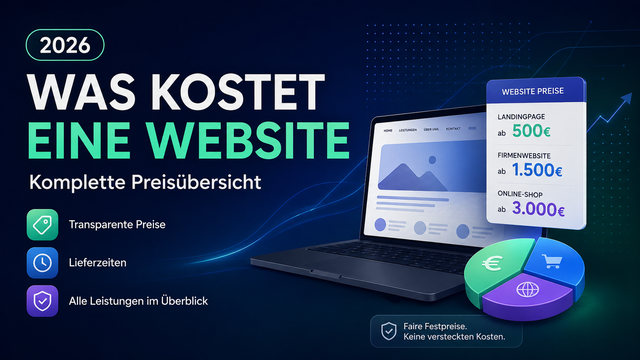
9. What Does Each Option Cost?
Pricing varies depending on the designer or agency, the complexity of the project, and the features required. Here are realistic ranges for the European market:
| Solution | Typical Price Range | What's Usually Included |
|---|---|---|
| Simple Landing Page | €800–1,500 | 1 page, contact form, mobile-friendly design |
| Premium Landing Page | €1,500–2,500 | Custom design, copywriting, A/B test setup, analytics |
| Small Business Website | €2,500–5,000 | 5–8 pages, basic SEO, CMS, blog |
| Professional Website | €5,000–10,000 | 10–20+ pages, full SEO, copywriting, advanced features |
| E-commerce Website | €5,000–30,000+ | Product catalogue, payments, inventory management |
Important notes on pricing:
- These prices are for the initial build only — maintenance, hosting, and updates are separate costs
- A cheaper landing page from a freelancer can outperform an expensive full website if it's better targeted
- The goal is not to spend more or less — it's to spend the right amount on the right tool for your current stage
✅ A €1,200 landing page that generates 20 leads per month is a better investment than a €6,000 website that generates none. Always evaluate ROI, not just cost.
10. Which Is Better for Google Search (SEO)?
If you want to understand why SEO strongly favours full websites, the logic is simple:
| Landing Page | Full Website (20 pages) |
|---|---|
| 1 page | 20 pages |
| 1 main topic | 20 different topics |
| 1 chance to appear in Google | 20 separate chances to appear in Google |
| 1 set of keywords | Hundreds of potential keywords |
Each page of your website is indexed separately by Google. Each page can rank for different search queries. A full website gives you exponentially more surface area in search results.
The blog multiplier
A website with an active blog can multiply this further. Every article you publish is another page Google can index. A business that publishes one article per month builds 12 new search entry points per year. After three years, that's 36 articles — each potentially bringing in a different group of visitors.
This is why some small businesses receive hundreds of website visitors per day from Google — without spending a single euro on ads. It's the result of consistently investing in content over time.
🔍 Landing pages can rank in Google — but only for 1–2 specific search terms. Full websites can rank for dozens or hundreds of terms simultaneously.
11. Which Is Better for AI Search? (GEO — Generative Engine Optimisation)
Most businesses have never heard of GEO. That's exactly why it's such an opportunity right now.
GEO stands for Generative Engine Optimisation — the practice of making your business visible in answers generated by AI tools like ChatGPT, Google Gemini, and Perplexity.
These tools are increasingly the first place people go when they have a business question. "Who is the best accountant for small businesses in my area?" "What should I look for in a web developer?" "Which cleaning companies in my city are most reliable?"
The AI assembles its answer by crawling and analysing content from the web. Businesses with rich, structured, trustworthy content get cited. Businesses with thin content get ignored.
| Content Factor | Landing Page | Full Website |
|---|---|---|
| FAQ section | Limited (usually 3–6 questions) | Extensive (can have dozens) |
| Case studies | Minimal space | Full dedicated pages |
| Expert articles / blog | None | Yes — ongoing |
| Depth of expertise signals | Low | High |
| Structured data opportunities | Limited | Extensive |
| Likelihood of AI citation | Low to moderate | High |
How to improve your GEO performance
- Publish detailed, helpful articles that answer real questions your customers ask
- Create thorough FAQ sections on each service page
- Build case studies that describe the problem, your solution, and the measurable result
- Use clear, well-structured language — AI tools prefer content that is easy to parse
- Establish your authority by being consistent: regular publishing beats sporadic bursts
GEO is still a relatively new field, which means the businesses that invest in it now will enjoy a significant head start over competitors who wait.
12. Real Business Scenarios
Theory is useful — but let's look at how this plays out for specific types of businesses:
| Business Type | Recommended Option | Why |
|---|---|---|
| Dental practice | Full website | Multiple services (implants, whitening, orthodontics), needs local SEO, patients research before booking |
| Freelance plumber | Landing page or small website (3–4 pages) | 1–2 core services, local area focus, phone calls matter more than content depth |
| SEO or digital agency | Full website | Credibility is everything — clients need to see case studies, blog, team, and proven results |
| New product launch / startup | Landing page | Test market demand before full investment; speed to market is critical |
| Online store / e-commerce | Full website with shop | Product pages, categories, checkout — a landing page cannot support this |
| Event venue / wedding venue | Full website | Couples spend weeks researching — they need galleries, pricing, reviews, and FAQs |
| Single-service contractor | Landing page | Fast to launch, focused on one service, drives ad traffic efficiently |
| Accounting firm | Full website | Multiple service types, professional credibility essential, blog builds trust over time |
The pattern is clear: if your business relies on trust, research, or multiple services, you need a full website. If you have one specific service and want to drive paid traffic efficiently, a landing page is your fastest path to results.
13. Frequently Asked Questions
Can a landing page rank in Google at all?
Yes — but with significant limitations. A landing page can rank well for one or two specific search terms if it is well-optimised. However, it will never have the broad visibility of a multi-page website with a blog. If Google search traffic is a priority for your business, a full website is the right investment.
When should I upgrade from a landing page to a full website?
There are clear signals: your service offering has grown beyond one or two options; you're getting leads but want to stop relying on paid ads; you want to build authority in your industry; or your competitors have full websites and you're being outranked in Google. Any of these is a strong signal to upgrade.
Can I expand a landing page into a full website later?
Technically, yes — but in practice, it's often easier to start fresh. Landing pages are typically built for conversion efficiency, not scalability. The design, structure, and platform may not support adding a blog, multiple service pages, and a CMS easily. If you know a full website is in your medium-term plans, discuss this with your developer upfront.
Which option is cheaper to maintain over time?
Landing pages are cheaper — there's less content to update, fewer pages to manage, and simpler hosting requirements. Full websites have more moving parts: you need to keep the CMS updated, publish content regularly to maintain SEO, and manage a larger set of pages. However, the ROI of a well-maintained website typically far outweighs the additional cost.
Which is better for Google Ads campaigns?
Landing pages almost always outperform full websites for paid ad campaigns. The reason is focus: a landing page removes distractions and guides the visitor to a single action, while a website homepage gives too many choices. For every €100 you spend on Google Ads, a dedicated landing page will usually produce more enquiries than sending that traffic to your homepage.
Will ChatGPT or other AI tools mention my landing page?
It's possible, but unlikely. AI tools tend to cite content-rich pages — detailed articles, comprehensive FAQs, and expert case studies. A landing page simply doesn't contain enough depth for an AI to cite with confidence. If appearing in AI-generated answers matters to your business, you need a full website with regular, high-quality content.
Do I need both a landing page AND a full website?
Sometimes, yes — and it's a smart strategy. Many businesses run a full website for organic SEO and brand building, while running separate landing pages for specific paid ad campaigns. This combination captures both long-term organic traffic and short-term paid traffic with maximum efficiency.
How long does it take to see results from each option?
A landing page connected to Google Ads can generate leads within 48–72 hours of going live. SEO results from a full website typically take 3–6 months to build, but they grow steadily over time and can eventually deliver leads at zero per-click cost.
What if my budget is very limited — which should I choose?
Start with a landing page. It's the lower-risk option when funds are tight. Generate some revenue from leads, validate your offer, and reinvest into building a full website when the business justifies it. This is exactly the model many successful small businesses have followed.
Can I build a landing page myself, or do I need a professional?
DIY builders like Wix, Squarespace, and Unbounce make it possible to build a basic landing page without technical skills. The challenge is that a professionally built landing page — with carefully crafted copy, proper conversion structure, fast loading speed, and A/B testing — will almost always outperform a DIY version. For a critical product launch or ad campaign, professional help is worth the investment.
14. Conclusion
The choice between a landing page and a full website is not about budget — it's about goals.
A landing page is the right tool when you need to move fast: test a new idea, launch a service, or get maximum results from a paid advertising campaign. It is focused, efficient, and delivers a clear return on investment when used correctly.
A full website is a long-term asset. It grows in value over time as you add content, earn Google rankings, build credibility, and become visible to the AI tools that an increasing number of people use to find businesses like yours.
The best decision is the one that matches where your business is right now — and anticipates where it needs to go next.
| Choose a Landing Page if... | Choose a Full Website if... |
|---|---|
| You're testing a new idea or service | You have multiple services to promote |
| You're running Google Ads campaigns | You want long-term organic traffic from Google |
| You need leads quickly with limited budget | You're building a brand that will last for years |
| You're validating demand before investing | You want to publish expert content and a blog |
| You offer one focused, specific service | You need to demonstrate authority and depth |
Not sure which option is right for your business?
We offer a free consultation to help you make the right choice — and we'll show you real examples from businesses in your industry.