Search Is Changing Faster Than Most People Realize
In the past, a user would open Google, browse through 5–10 websites, compare offers, and only then make a decision.
Today, it increasingly works differently:
“Recommend me a good web agency in Germany for a website with SEO and Google Ads.”
And the AI instantly provides a ready-made answer. Without dozens of tabs. Without studying search results. Without visiting most websites.
And this creates a new problem for businesses:
What if the AI doesn’t know your company at all?
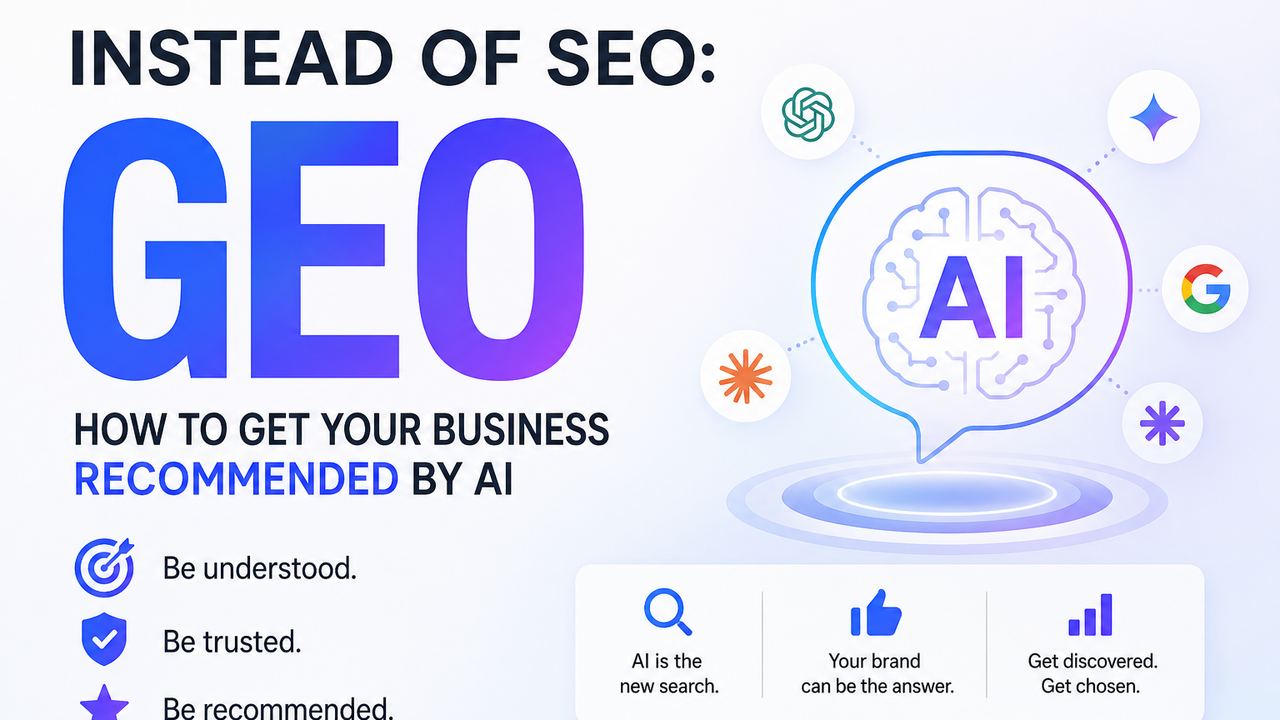
That is exactly why a new discipline is emerging right now — GEO (Generative Engine Optimization).
If SEO is the battle for positions in search results, then GEO is the battle for being mentioned inside AI-generated answers.
What GEO Means in Simple Terms
GEO is the optimization of your website and brand for AI systems:
- ChatGPT
- Gemini
- Claude
- Perplexity
- Copilot
The goal of GEO is to ensure that AI understands your website, trusts it, considers it useful, and uses it as a source of information.
Why Traditional SEO Is Gradually Losing Importance
SEO is not dying. But user behavior has already changed.
Before
The user typed: “Website creation Berlin”
Then: open websites, compare, read, choose.
Today
The user writes:
“I need a website for a construction company in Germany — fast, modern, with SEO and advertising. Who should I choose?”
And the AI analyzes sources, compares companies, draws conclusions, and recommends specific brands. The user may never even open the search results.
The Biggest Change: AI Evaluates Usefulness, Not Keywords
Old SEO: Keyword density, repeating “buy website Berlin” 20 times, creating separate pages for every keyword.
GEO works differently. AI looks for: clear explanations, structure, expertise, real evidence, numbers, case studies, reviews, comparisons, FAQs, microdata markup, and confirmation from other websites.
How AI Systems Decide Whom to Recommend
| Factor | Importance |
|---|---|
| Usefulness of content | Very high |
| Brand reputation | Very high |
| Mentions on other websites | Very high |
| Website structure | High |
| FAQ and answers to questions | High |
| Schema.org | High |
| Website speed | Medium |
| Keywords | Low |
| Text volume | Low |
The Most Common Mistake Businesses Make
Most companies still build websites like this: “Services,” “About Us,” “Contact,” 500 words of text, and a few SEO keywords. That was enough for Google in 2018. It is not enough for AI systems. AI needs a website that truly explains a topic.
What AI Systems Value the Most
1. Articles That Fully Answer a Question
Bad example: “Website creation in Berlin”
Good example: “How to choose a web agency in Germany: pricing, mistakes, timelines, SEO, technology comparison, and what influences the final result”
AI prefers content that answers all questions at once, helps users make decisions, has a clear structure, and provides concrete information.
2. FAQ Sections
FAQ sections are incredibly important today. Users ask AI questions in natural language, for example:
- How much does a website cost?
- What is better — WordPress or Nuxt?
- How long does it take to build an online store?
- What affects SEO?
- Why is my website slow?
If you already provide ready-made answers, it becomes easier for AI to use them.
How to Create a Good FAQ
Bad FAQ:
Question: How much does a website cost?
Answer: The price depends on the project.
That is useless.
Good FAQ:
The cost of a business website usually starts at €1,500–3,000. Online stores start from €3,000. Pricing depends on: number of pages, custom design, SEO, integrations, and multilingual support.
This answer is: useful, concrete, structured, and easy for AI to quote.
Why Structured Data (Schema.org) Is Essential Today
Structured data helps AI systems understand your website. Not “guess” — but understand it precisely.
What You Absolutely Need
For businesses: Organization, LocalBusiness
For services: Service
For articles: Article
For FAQs: FAQPage
For authors: Person
What It Changes
Without structured data: “possibly an agency”
With structured data: “this is a web agency from Germany offering SEO and website development”
The difference is enormous.
llms.txt — The New robots.txt for AI Systems
Many people still know nothing about it. But llms.txt is gradually becoming an important standard.
What Is llms.txt?
A file that helps AI understand: which pages are important, where documentation is located, where articles and the knowledge base can be found, and what may be used for training and responses.
Example llms.txt
# EvolaTec

> Web agency in Germany.
> Website development, SEO, Google Ads.

## Main Pages

- https://evolatec.de/
- https://evolatec.de/seo
- https://evolatec.de/google-ads
- https://evolatec.de/web-development

## Blog

- https://evolatec.de/blog/geo-vs-seo
- https://evolatec.de/blog/website-speed

## Contact

- https://evolatec.de/contact
What Is llms-full.txt?
If llms.txt is a short sitemap for AI, then llms-full.txt is a complete knowledge base. It may contain: service descriptions, FAQs, processes, documentation, case studies, advantages, terminology, and important articles.
| File | Purpose |
|---|---|
llms.txt | Short navigation |
llms-full.txt | Complete knowledge base |
Just like with sitemap.xml in the past — those who adopt it early gain an advantage.
GEO Strongly Depends on Reputation Outside Your Website
AI does not trust only your website. It analyzes: articles, reviews, Reddit, forums, LinkedIn, YouTube, directories, media, and social networks.
If nobody talks about you outside your website — AI trusts you less.
| Source | Impact |
|---|---|
| Reviews | Very high |
| Case studies | Very high |
| Mentions in articles | Very high |
| YouTube | High |
| Reddit / Forums | High |
| Medium | |
| Social networks | Medium |
How to Write Content for GEO
Ideal Article Structure
- Answer immediately at the beginning — no long introductions.
- Subheadings every 200–300 words — AI loves structure.
- Tables — quoted much more often than plain text.
- FAQ at the end — absolutely essential.
- Real numbers — loading times, traffic growth, CTR, costs, deadlines.
- Comparisons — for example WordPress vs. Nuxt.
| WordPress | Nuxt |
|---|---|
| Slower | Faster |
| More plugins | Cleaner architecture |
| Frequent security issues | More secure |
How to Know Whether GEO Is Working
1. Check Mentions Manually
Ask AI systems: “Best SEO agencies in Germany,” “Who builds fast websites with Nuxt,” “Which agency should I choose for Google Ads.” Then monitor — are you mentioned, how are you described, and who are you compared with.
2. Monitor Brand Searches
If people begin searching for “EvolaTec,” “EvolaTec reviews,” or “EvolaTec Germany,” it is a sign that GEO is starting to work.
3. Track Traffic from AI Sources
Analytics already shows traffic sources like: chatgpt.com, perplexity.ai, copilot.microsoft.com.
4. Add a Question to Your Contact Form
“How did you hear about us?” — with the option “AI assistant / neural network.”
Step-by-Step Plan for Implementing GEO
Step 1. Build the Technical Foundation
sitemap.xmlrobots.txtllms.txtllms-full.txt- Schema.org (FAQPage, Service, Organization)
- OpenGraph
- Canonical tags
Step 2. Improve Content
Every important page should: explain the topic, answer questions, include tables and FAQs, and have a clear structure.
Step 3. Strengthen Reputation
You need: case studies, reviews, publications, and external mentions.
Step 4. Regularly Check AI Responses
This should be done consistently.
Step 5. Create Expert-Level Content
Today, websites with generic “SEO texts” do not win. Websites that truly explain, help, and demonstrate expertise do.
What Comes Next
Most likely: AI search will become the norm, clicks will decrease, the role of branding will grow, and trust will become more important than keywords.
And the key question of the future will no longer be: “What position does the website rank in Google?”
But rather: “Will AI mention your brand first?”